
OCM: Model Weights as an OCM Component
Author: Artem Lytvynov
Thalamus serves large language models, but it does not manage the model weights, which come from external providers — chiefly Hugging Face. That is convenient, but the weights are outside our control.
Hugging Face is a single point of failure outside our control:
- It can go down.
- It can be breached.
- It can apply censorship to individual models, or restrict who is allowed to download them — SAP included.
- A team that wants to run its own model must upload it to Hugging Face first, which adds friction and a dependency on a public platform.
For a European sovereign-cloud offering under the ApeiroRA and IPCEI-CIS umbrella, depending on a US registry we do not operate is not acceptable. We need a registry we own and control.
OCM (Open Component Model) provides a protocol built for exactly this: describing, signing, and transporting software artifacts across registries in a verifiable, vendor-neutral way — a good fit for sovereign-cloud requirements. The OCM project ships a model-server: a proxy that makes OCM components stored in any OCI registry look like a Hugging Face Hub (and Ollama, OpenAI, and MLflow) endpoint. Clients do not need to change — they still think they are talking to Hugging Face. But the bytes now come from a registry we choose: GitHub Container Registry, AWS ECR, Azure ACR, or a sovereign OCI registry such as Keppel.
At the hackathon, we drafted an end-to-end integration of Thalamus with the OCM protocol and the model-server, proving we can replace Hugging Face with any OCI-compatible storage. Concretely, we:
- Packaged a lightweight demo model (
arnir0/Tiny-LLM, ~26 MB) as an OCM component; - Stored it in the GitHub Container Registry (GHCR) as a versioned OCM component;
- Pulled it from inside a Kubernetes cluster through the model-server's Hugging Face-compatible API;
- Deployed it into a vLLM engine managed by Thalamus and served inference — with no code in the inference path aware that the weights never touched Hugging Face.
The upstream work landed in jakobmoellerdev/model-server#1, in collaboration with Jakob Möller, who maintains the model-server.
Technical design
The model-server is a stateless Go proxy. It reads OCM component descriptors from one or more OCI registries, builds an in-memory index of the models it finds, and exposes them over four API surfaces simultaneously — the point being that an unmodified Hugging Face, Ollama, OpenAI, or MLflow client can consume them. It does no inference and no proxying of weights beyond streaming them through; it is pure model distribution with supply-chain traceability from OCM signatures.
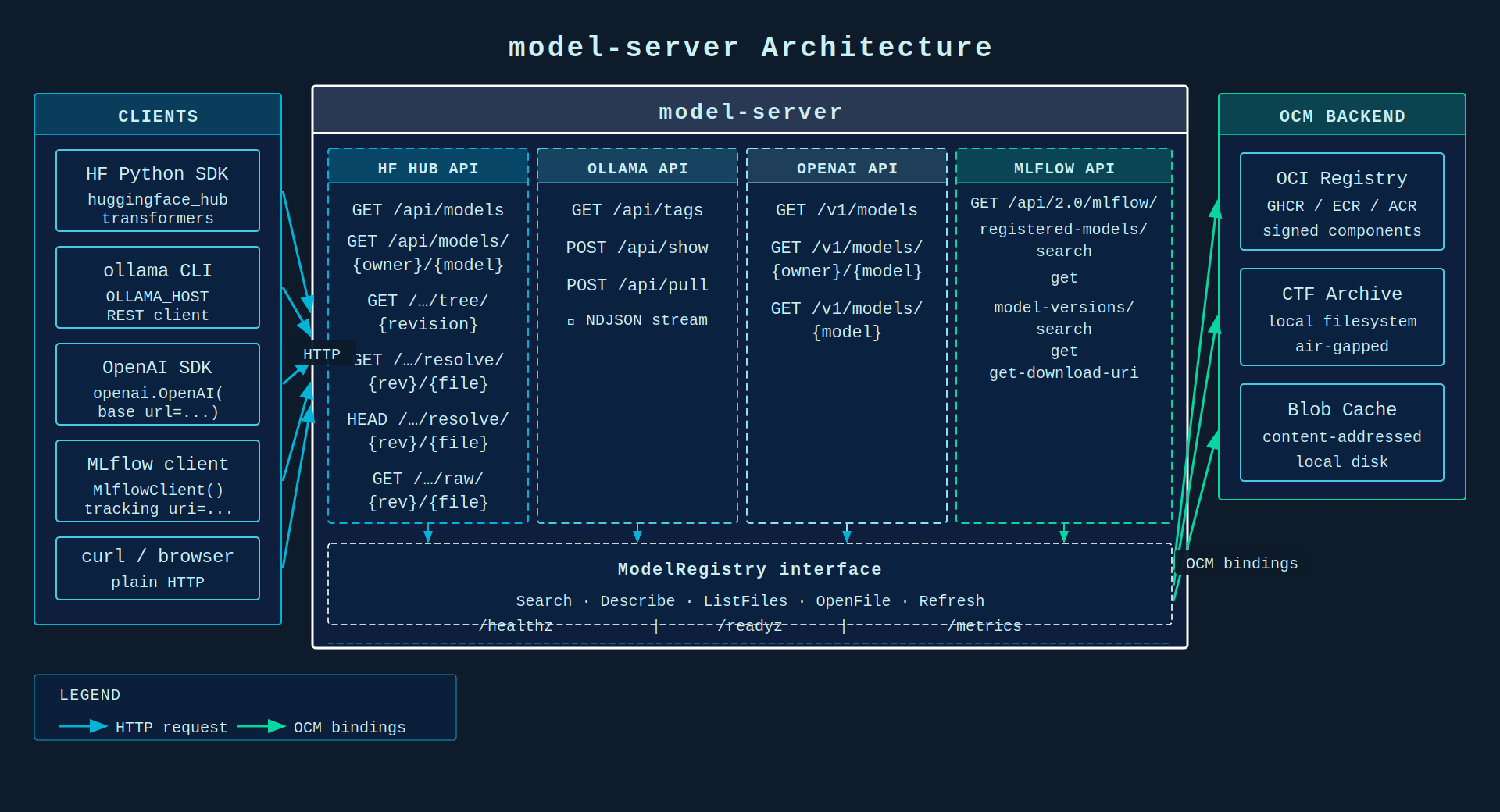
Diagram source: jakobmoellerdev
1. Packaging the model as an OCM component. A model becomes an OCM component version whose resources are its files (weights, config, tokenizer, model card). Model metadata is carried in the ext.ocm.software/model-server.* label namespace, which is exactly what the proxy reads to reconstruct a Hugging Face-style model record:
# real-model-constructor.yaml (excerpt)
components:
  - name: example.org/tiny-llm          # OCM names must be lowercase
    version: 1.1.0
    provider:
      name: arnir0
    labels:
      - name: ext.ocm.software/model-server.model-id
        value: "arnir0/Tiny-LLM"        # the public HF-style id clients ask for
      - name: ext.ocm.software/model-server.task
        value: "text-generation"
      - name: ext.ocm.software/model-server.library
        value: "transformers"
    resources:
      - name: modelsafetensors
        type: modelWeights
        input:
          type: file
          path: Tiny-LLM/model.safetensors
          mediaType: application/octet-stream
        labels:
          - name: ext.ocm.software/model-server.filename
            value: "model.safetensors"
          - name: ext.ocm.software/model-server.format
            value: "safetensors"
      # ... config.json (modelConfig), tokenizer files (tokenizer), README.md (modelCard)
2. Publishing to GHCR. The OCM CLI builds a local transport archive (CTF) and transfers it to the registry:
ocm transfer componentversions \
  "ctf::./transport-archive//example.org/tiny-llm:1.1.0" \
  ghcr.io/jakobmoellerdev/model-server/models --copy-resources
3. Serving it as Hugging Face. The server is configured to read that GHCR repository. When a client calls the HF API, the proxy resolves the component, maps its labels and resources back into HF response shapes, and streams resource blobs on /{model}/resolve/{revision}/{file}:
# model-server.yaml (excerpt)
ocm:
  repositories:
    - name: ghcr-models
      type: OCIRegistry
      url: "ghcr.io/jakobmoellerdev/model-server/models"
      credentialsRef: ghcr-creds
  blobCache:
    path: /var/cache/model-server
    maxSizeBytes: 10737418240   # 10 GiB
apis:
  hfhub: { enabled: true }
credentials:
  ghcr-creds:
    username: ${GHCR_USERNAME}
    password: ${GHCR_TOKEN}
The core of the fetch path lives in internal/ocm/client.go. Two details there are what actually made the integration work: proper OCI token exchange against GHCR (via the ORAS auth client), and caching so repeated metadata and blob reads do not re-hit the registry:
// ORAS auth client → real OCI bearer-token exchange for GHCR
orasClient := &auth.Client{
    Client: httpClient,
    Cache:  auth.NewCache(),
    Credential: auth.StaticCredential("ghcr.io", auth.Credential{
        Username: cred.Username,
        Password: cred.Password,
    }),
}

// On-disk blob cache, keyed by a hash of component:version:resource
func (c *Client) GetCachedResource(ctx context.Context, cv ComponentVersion, resourceName string) (io.ReadCloser, int64, error) {
    cacheFile := filepath.Join(c.cachePath, cacheKeyForResource(comp.Name, comp.Version, resourceName))
    if info, err := os.Stat(cacheFile); err == nil && info.Size() > 0 {
        // blob cache hit — serve from disk
        ...
    }
    // blob cache miss — fetch from registry, stream to a temp file, atomic-rename into cache
    ...
}
4. Wiring it into Thalamus + vLLM. From the inference side nothing exotic happens: vLLM's Hugging Face client is pointed at the model-server via HF_ENDPOINT, and the model is declared as an ordinary Thalamus Model. vLLM then pulls arnir0/Tiny-LLM (the respective component is named example.org/tinyllm) — weights, tokenizer, config — straight from the OCM component, and serves it:
# thalamus values (CPU profile)
    - slug: tiny-model-ocm
      model: example.org/tinyllm
      hfEndpoint: "http://model-server.model-server.svc.cluster.local:8080"
      accelerator: cpu
      replicas: 1
      extraArgs:
        - "--max-model-len=512"
        - "--dtype=float32"
        - "--revision=1.1.0"
        - "--chat-template"
        - "{% for message in messages %}{{'<|im_start|>' + message['role'] + '\n' + message['content'] + '<|im_end|>' + '\n'}}{% endfor %}{% if add_generation_prompt %}{{ '<|im_start|>assistant\n' }}{% endif %}"
      extraEnv:
        - name: VLLM_USE_V1
          value: "0"
        - name: VLLM_CPU_KVCACHE_SPACE
          value: "4"
        - name: HF_HUB_ETAG_TIMEOUT
          value: "60"
        - name: HF_HUB_DOWNLOAD_TIMEOUT
          value: "120"
      # ...
hfEndpoint overrides the default Hugging Face URL, allowing vLLM to call the proxy. Model name follows both vLLM and OCM naming conventions, while version is provided through the --revision flag.
Challenges
Getting there was a fight against a stack of small, sharp edges.
- Placeholder model, fake architecture. The first component shipped 16-byte stub weights and a
config.jsondescribing a non-existentTinyGPTForCausalLMarchitecture, which Transformers/vLLM reject outright. We replaced it with the realarnir0/Tiny-LLMwhich can actually serve inference for completeness of the task. - Multi-segment model IDs vs. the router. Public model ids like
arnir0/Tiny-LLM— and the far longer OCM component names — have slashes in them, which the chi router cannot match with a fixed/{owner}/{model}pattern. We switched the HF and OpenAI routes to catch-all patterns and parse the id (and theresolve/raw/treeverb and revision) out of the path in the handler. - OCM naming rules. OCM component and resource identifiers must match a strict lowercase schema.
arnir0/Tiny-LLMwas rejected for the uppercase; resource names could not contain dots, hyphens, or underscores. SoTiny-LLMbecame the componentexample.org/tiny-llm, andmodel.safetensorsbecame the resourcemodelsafetensors, while the public id the client sees is preserved separately in themodel-idlabel. - vLLM naming rules. OCM versions a component as
name:version, but vLLM rejects a colon in the model name, and there was no obvious way to ask it for a specific version. This sent us down implementing a hack that encoded the version into the name with an underscore (tinyllm_1.1.0). It turned out vLLM already exposes a--revisionflag for exactly this. - OCM CLI versioning. The CLI flag syntax and packaging protocol changed between OCM releases. The version installed via
homebrewappeared to be outdated. After discovering this the following day, we had to repackage the models. - Listing over plain OCI. An OCI registry has no OCM "list all components" call (GHCR's catalog endpoint is disabled), so the index cannot be auto-populated by discovery alone. For the demo we relied on direct lookup by component name (and a local CTF archive, which does support listing) as the workaround.
- Slow model downloads. This was the biggest challenge, taking most of our attention and time. We added GHCR credentials to speed up downloads, but the download speed did not improve. The
TinyLLMmodel (25 MB) was taking over a minute to pull, causing timeout failures on the vLLM side. Increasing the timeouts via environment variables changed the error message, but the root cause remained the same. We later discovered that vLLM uses the HF client, which has internal timeouts that cannot be configured. Forking vLLM was not an option, so we investigated the slowdown. It turned out that the HF client inside vLLM interacted with OCM-packaged models in an unexpected way. Instead of pulling a model once and caching it locally, it made many calls per file — forconfig.json,tokenizer_config.json, and others. The model-server had no cache, so the entire OCM component (26 MB) was downloaded on every request, resulting in gigabytes of data transferred and rate limiting from GHCR. As soon as a basic cache was implemented, downloads became fast and progress unblocked.
Further development
What we built is a working draft, not a production system. Getting an OCM-backed model registry into production for real-world models is an epic-sized effort in its own right. The largest gaps:
- Stable multi-model deployment at real sizes. Everything so far was validated with a ~26 MB toy model. Production models are hundreds of gigabytes, and packing/unpacking speed, memory pressure, and concurrency will surface a whole new class of problems that simply do not appear at 26 MB.
- Download speed. Hugging Face parallelizes downloads to fetch large models quickly. The model-server currently does a trivial single-threaded pull. We need to research what different OCI registries support (chunked/parallel/range reads) and implement real parallelism in the server.
- Full feature coverage. Everything we intend to depend on must be tested deliberately: the HF API surface (and possibly others), caching, OCI integrations across registries, OCM compatibility, and versioning.
- Proper caching. At 26 MB the cache barely matters; at 100+ GB it is the difference between a usable platform and an unusable one. The current blob cache is a starting point, not a solution.
- A large-model packaging workflow. Turning an arbitrary model into a signed OCM component today is a hand-run script. This needs to become a repeatable, automated workflow before anyone can onboard models at scale.
Beyond that list, the strategic payoff is registry independence: because the model-server speaks plain OCI, the same setup can point at Keppel or any other sovereign OCI registry instead of GHCR, which is the whole reason this matters for a European sovereign cloud. The concrete next steps and ownership are still to be discussed.