
Architecture
Thalamus is a Kubernetes-native LLM inference stack.
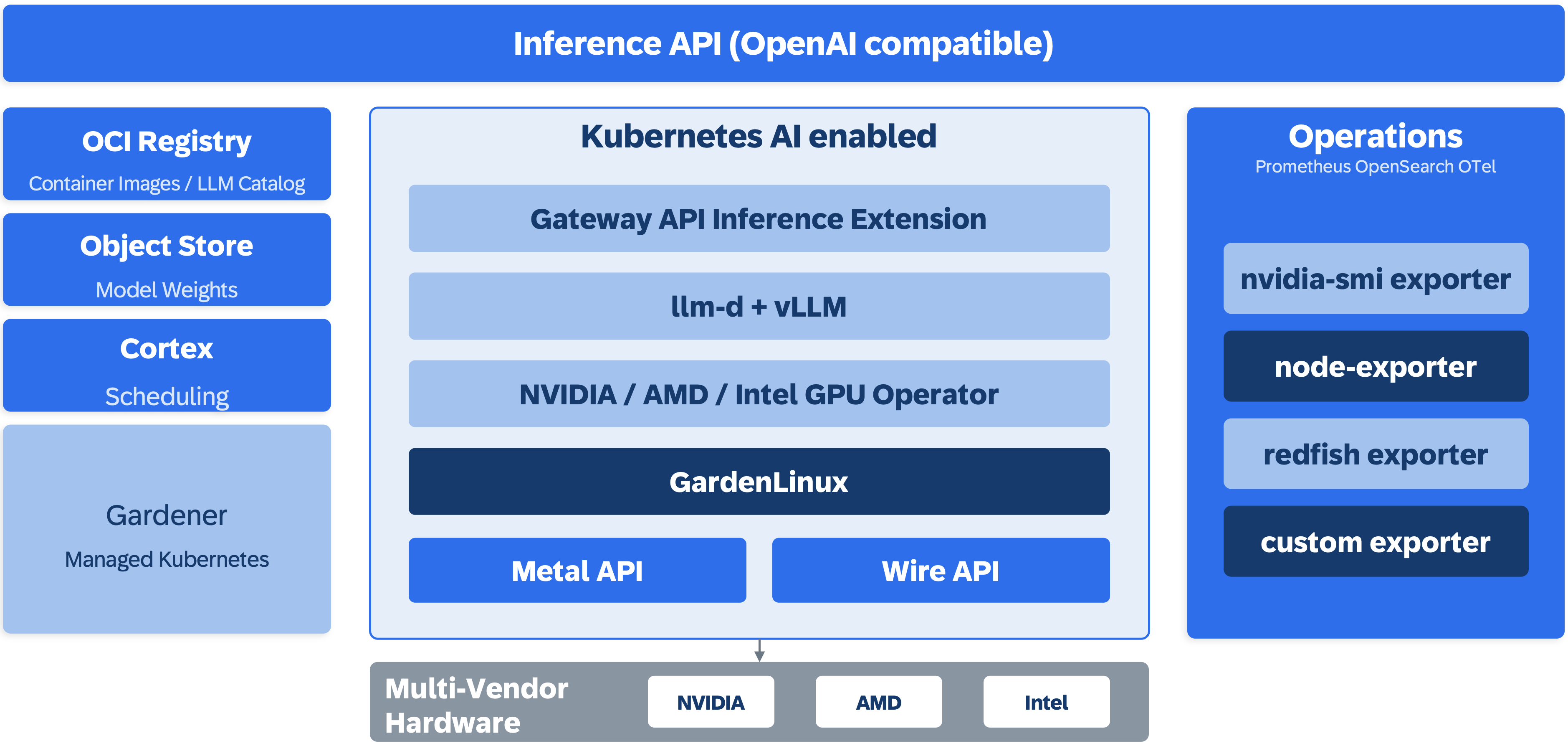
It requires an AI-enabled Kubernetes cluster, for example one provided by Gardener. The underlying hardware lifecycle is managed via metal-api and wire-api. Model weights are stored in an object store, container images in an OCI registry. Thalamus' Custom Resource Definitions bundle these together as a model catalog. Operations tooling is built in via industry-standard exporters and custom extensions.
Inference API
A single OpenAI-compatible HTTP endpoint serves all clients. Routing to the correct model and replica is handled inside the cluster by the Gateway API Inference Extension and the llm-d Endpoint Picker. See Request flow for a step-by-step walkthrough.
Kubernetes AI runtime
Gateway API Inference Extension
Model-aware HTTP routing built on the Kubernetes Gateway API. Each model is served by an InferencePool; requests are routed to the right pool based on the requested model.
llm-d + vLLM
Model servers run vLLM behind llm-d, which provides KV-cache aware load balancing across the replicas of a model.
NVIDIA / AMD / Intel GPU Operator
Vendor GPU operators install drivers and expose accelerators to the cluster as schedulable resources.
GardenLinux
The host operating system on the cluster nodes.
metal-api and wire-api
The bare-metal and network-fabric APIs that manage the lifecycle of the physical machines and data-center network underneath Kubernetes.
Platform services
Keppel
The OCI registry that hosts container images and the LLM catalog referenced by Thalamus' Custom Resource Definitions.
Ceph
The object store that holds model weights.
Cortex
GPU scheduling, including gang scheduling for multi-GPU model instances.
Gardener
Managed Kubernetes. Provisions and operates the AI-enabled clusters Thalamus runs on.
Operations
Metrics, logs, and traces flow through Prometheus, OpenSearch, and OpenTelemetry. Infrastructure and inference signals are surfaced through industry-standard exporters and custom extensions:
- nvidia-smi exporter: GPU utilization, memory, temperature, power
- node-exporter: host-level CPU, memory, disk, network
- redfish exporter: hardware/BMC metrics
- custom exporters: inference-specific metrics
Multi-vendor hardware
Thalamus runs on commodity server hardware from multiple vendors with accelerators from NVIDIA, AMD, and Intel.
Confidential computing
For workloads that require strong data isolation, Thalamus supports GPU confidential computing. Model weights are sealed inside an attested GPU boundary, isolated from the operator and co-tenants. Customer prompts and context are processed inside the same boundary. This enables:
- Partner weight protection. Proprietary weights can be deployed to infrastructure the model owner does not control.
- Restricted-data inference. Data that cannot leave a controlled boundary can still be processed.
Deployment topologies
The same stack runs in two topologies:
- Datacenter. Full stack co-located in a managed Kubernetes cluster.
- Satellite. Air-gapped subset of the stack at the edge. The satellite carries its own OCI registry, inference gateway, model instances, and monitoring; the central datacenter retains the source-of-truth registry, object store, model catalog, and identity provider.